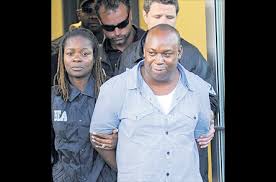
 Former Tivoli Gardens don Christopher ‘Dudus Coke is said to have sent a message to Prime Minister Bruce Golding in May 2010 demanding that he “find a way to deal with this” or “come good” if he intended to apprehend him for extradition to the United States.
Former Commissioner of Police Owen Ellington testified yesterday, during the continuation of the Tivoli enquiry at the Jamaica Conference Centre, that the message came through the Reverend Al Miller, whom he had asked to speak to Coke about turning himself in to the police.
Ellington testified that he had asked Miller and then Political Ombudsman Bishop Herro Blair to speak with Coke with the view of securing his peaceful surrender.
He said he spoke with the two clergymen between May 18 and 24, 2010 on the request of a then Government minister, whom he did not identify during his testimony — a stance with which Commission Chairman Sir David Simmons took issue.
“[Rev Miller] returned two days later and said to me, ‘I saw the man and the man say to me that if it was the PNP in power they would know how to deal with it. Tell Bruce Golding to find a way to deal with it. I’m not going anywhere, and if him a come fi mi him haffi come good’,” Ellington said Miller reported back to him.
He said Miller contacted him after the start of the May 24 operation to apprehend Coke to say that he had secured the surrender of a brother and sister of Coke, and that he was still trying to secure the surrender of the then Tivoli Gardens don.
He said he had asked Blair first to talk with Coke about a peaceful surrender. He said Blair, who also went to see Coke in Tivoli Gardens, reported back that Coke said he will not be surrendering. Blair, Ellington testified, said he has had dealings with the military, and that he’d never seen so many rifles in his life as he saw in Tivoli Gardens.
“[He said] he would be praying for me and my officers,” Ellington testified during his evidence-in-chief from Deborah Martin, one of the attorneys for the Jamaica Constabulary Force (JCF).
Prior to Ellington taking the stand at the enquiry looking into the operation to apprehend Coke, Golding who was called back to be questioned by Martin and Queen’s Counsel Jacqueline Samuels-Brown (Miller’s lawyer), said he was “guardedly optimistic” about Miller getting Coke to surrender. He testified that he knew that Miller had contact with the United States Embassy and the police high command about getting Coke to surrender.
Seventy-four civilians were killed in the operation to apprehend Coke and restore law and order to the West Kingston community and its environs.
Questioned on the issue by Garth McBean, QC, the attorney for the commission, Ellington said he had no report as to what number of those who were killed had been shooting at the police.
He had testified earlier that damage to JCF assets as a result of the operation had been calculated at $126 million. And that the list of finds associated with the operation (apart from guns, ammunition and explosives) included police radios, denim similar to that worn by police, gun holster, seven licence plates — including a diplomatic licence plate — and eight ballistic vests.
Jamaica Observer



 The Pen Hustle With Brandy Cavalli
You must be logged in to post a comment.