 African-Americans first formed street gangs in the late 1920s and early 1930s on the Eastside of Los Angeles near Central and Vernon Avenues. They were also forming clubs in the downtown area of Los Angeles where they first settled around the same time. During the years to follow, African-Americans began to move south from downtown Los Angeles, down Central Avenue towards Slauson Avenue. The area between Slauson Avenue and Firestone (Manchester), during the 20s and 30s was occupied primarily by white residents, but just south of Firestone, African-American populations were growing in Watts between 92nd Street and Imperial.
During the 1920s and 1930s, some of the Black gangs that were active in Los Angeles were the “Goodlows,” “Kelleys,” “Magnificents,” “Driver Brothers,” the “Boozies,” and the “Blodgettes” which hung out in an area off the Imperial Freeway known as the “Blodgette Track,” where the 105 Freeway is today. The “Boozies” were a family of many brothers and friends who were involved in prostitution and robbery. The guys frequented the Jefferson Park area on Los Angeles and hung out on Denker Avenue. The “Magnificents” were a group of youths from the Central Avenue on the eastside of LA. Eventually these gangs faded in the late 1930’s as the youths became older. Gangs during this time were strictly juvenile in nature, and those reaching their late teens distanced themselves from the gang.
The Clubs of the mid 1940s to 1965
In the mid 1940’s some new Black gangs began to form in the Central Ave area, and in East Los Angeles. Some of the gangs that were known during this period were the Purple Hearts, 31st Street, and 28th Street. By the late 1940s several more clubs appeared.
In the late 1940s clubs in the Black community were gaining popularity. Some were early attempts at political organizations but several clubs were formed as protective mechanisms against White violence from the white clubs of the time. Because of the increased migration of Blacks from the South during WWII, White residents developed a resentment towards the new migrants.
Some of the Black clubs that formed were involved in petty theft, robbery and assaults, but murder was extremely rare. Weapons of choice were chains, bats, and occasionally knives, and disputes were mostly settled by hand to hand combat. The peak period of these groups occurred during the early 1960s and identifying these Black youths as “gangs” was started by the Los Angeles Police Department.
The car clubs were also associated as gangs. The car clubs dominated through out the 1950s, and some of the popular car clubs in Los Angeles during that time were the “Low Riders” the “Coasters” the “Highwaymen” and the “Road Devils.” Other major territorial clubs from the 1950s and 1960s were the “Businessmen(1957-1965),” the “Gladiators,” the “Slausons (1952-1965),” “Rebel Rousers,” the “Huns,” “Farmers” from Watts, and “Blood Alley” just to name a few. By 1965 these club forged an alliance and participated in the Watts Rebellion. After the August rebellion of 1965 many of these gang members turned their efforts in other directions. Many political organization and radical movements developed during the years from 1965-1969. Bunchy Carter, who was once a Renegade Slauson (A Los Angeles Street Gang from the late 50’s to 1965), became the leader of the Los Angeles Chapter of the Black Panther Party. Other key figures that were influential into the Black consciousness of the 1960s, was Ron Wilkins, William Sampson, Gerald Aubry, Robaire Nyjuky, and Hakim Jamal. They were all former club members prior to 1965.
Late 1960’s, early 1970’s
As Black groups became more socially conscience to racism and police brutality, the FBI and LAPD considered these groups as radical and a threat to the national security of the United States. In January 1969 Bunchy Carter and John Huggins were murdered at Campbell Hall at UCLA, in a dispute with US members. Geogre and Ali Stiner of US organization were arrested, convicted, and sent to San Quentin prison for their involvement. Claude Hubert who was also involved was not charged. There are still many unanswered questions about why Carter and Higgins were killed, but some insist that Karenga’s US gunmen where police infiltrators working with the FBI, while others say that Carter and Huggins were armed and attacking an US associate when they were shot and killed. Whatever the case, this was a turning point in Black Los Angeles identity as youths who were too young to participate in the movement with organizations like the Black Panther Party and US, began to form their own groups as COINTELPRO tactics and actions of the LAPD Criminal Conspiracy Section left ineffective any Black political organizations. (I discuss this in more detail in Chapter 4 of my manuscript.) In the aftermath of several killings and incarcerations of those involved in the black movement, Raymond Washington, (b. August 14, 1953- August 1979) a 15-year old youth who attended Fremont High School, Locke High School and who frequented the area of Washington High School in Los Angeles, got together a few youths and started a gang called the Baby Avenues. The Avenues were a gang of older youths who had been active since approximately 1968 and Raymond Washington along with Stanley “Tookie” Williams, Avalon Gardens resident Jimel Barnes and a few other youths looked-up to and admired the Avenues ran by the Munson brothers. They attempted to preserve the Panther aura, so in 1969 Raymond Washington created the “Baby Avenues,” and to represent the new generation of this new group he called it the Avenue Cribs, or Baby Avenues. The word Crip was a derivative of the word Crib, but how the use of Crip occurred is not clear according to the available literature, but I discuss this more in depth by providing an account of how the term Crip materialized in my manuscript. By early 1972, the use of “Crip” had been entrenched into Los Angeles Gang culture and the term Crib had been phased out. In the early days there were not that many Crip gangs. Near Fremont High School there were the Eastside Crips, across the Harbor Freeway is where the Westside Crips started, and in Compton there were the Compton Crips. Raymond Washington had organized the beginnings of all these Crip sets, by hooking up with other youngsters like Stanley Williams and Jimel Barnes. By late 1971 the Avalon Garden Crips and the Inglewood Crips joined forces with the Crip sets as did the Hoover Groovers on the Westside and the 43rd Street Crips on on the Eastside. The L.A. Brims which began in 1969 on the westside were a powerful street group, but they were NOT affiliated with the Crips, and the Blood alliance had not been established. Several gangs which eventually became part of the Blood family had already existed though. There were also the Piru Street Boys in Compton, the Bishops, Athens Park Boys and the Denver Lanes. The Pirus, which are Bloods now, actually hung out with Raymond Washington and the Compton Crips but in 1972 Mac Thomas was opposed to an alliance with the Pirus and it did not endure. For a couple months they were known as the Piru Street Crips.
During the summer of 1972, the Crips from Compton, and the Pirus had a conflict, causing the Pirus to completely disassociate themselves from the Crips. The Pirus turned to the Lueders Park Hustlers for back-up and they created a small alliance against the Crips. Also that same year, the Crips had murdered an L.A. Brim member Lil Country. The Pirus and Brims eventually linked up. Others that were part of this early alliance were the Denver Lanes and the Bishops.
How to combat Crip intimidation was discussed along with the creation of a new alliance to counter the Crips. At that time the color of bandannas was not important, but since the Crips were known to were blue bandanas, the Pirus and the other groups decided to discontinue the wearing of blue bandannas. They decided to take on the wearing of an opposite color, red, and created a united organization which later became known as the Bloods. The Pirus, Brims, Athens Park Boys, and Pueblos decided to unite with the Bloods, and soon after, other groups who had been threatened or attacked by Crips joined the Bloods.
1980s and 1990s
By 1980 there were 30,000 gangs members in Los Angeles County, and by 1982 gang members started to deal heavily in narcotics. Crack cocaine was a new drug and gang members were earning thousands of dollars literally over night. Throughout the 1980s homicides increased each year from 1985 to 1992, but after the Civil unrest of 1992 gang homicides remained stable.
Written by Alex Alonso, Street Gangs.com

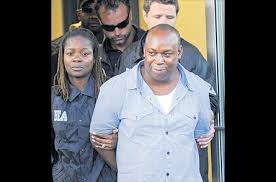 Former Tivoli Gardens don Christopher ‘Dudus Coke is said to have sent a message to Prime Minister Bruce Golding in May 2010 demanding that he “find a way to deal with this” or “come good” if he intended to apprehend him for extradition to the United States.
 The Pen Hustle With Brandy Cavalli
You must be logged in to post a comment.