
Former Police Commissioner Testifies That Jamaica Was Fortunate Security Forces Responded To Dudus Coke’s Tivoli Gunmen

Jamaica Security ForcesThe former Chief of the Jamaican Defense Force stated in his testimony that Jamaica was fortunate that the security forces responded in May 2010 to the threat posed by gunmen associated with then Tivoli Gardens don Christopher ‘Dudus’ Coke. At the same time, he expressed deep disappointment with the level of social intervention in Tivoli Gardens following the security forces’ operation to arrest Coke.

Ellington, the former police commissioner, made the remarks while being questioned by Professor Anthony Harriott, a member of the panel of three commissioners looking into the operation by the security forces in May 2010 to apprehend Coke — who also goes by the name Omar Clarke — and restore law and order to the West Kingston area and sections of the Corporate Area and St Catherine.

“Jamaica is fortunate that the security forces responded to the threat as quickly as they did and with the impact it had,” Ellington said, adding at one point that “it would be anybody’s guess where Coke’s office would be today” if his Presidential Click criminal gang was successful in its bid to spread the resources of the security forces thin, and broke its will with its planned co-ordinated attacks.

Ellington likened the gang to “insurgents” and said that it presented itself as a “surrogate government”, which sought to expand its power and “perhaps political influence”. He also said that the gang threatened the operation of the Government with its targeted attacks leading up to the May 24, 2010 operation that led to the death of just over 70 civilians. A member of the Jamaica Defence Force was killed in the operation and several other members of the security forces injured.

“We were left with no choice,” Ellington said, noting that the police did everything they could to avoid a violent confrontation with the gang, and again expressed regret at the loss of civilian lives.

Coke is now serving time in the United States following his extradition.

Yesterday, Ellington said he was disappointed with the social intervention in the community. “I am very, very disappointed that not much has happened, save and except for the work of the security forces. If you go there you will see that the police and soldiers have become permanent fixtures and you will see the work they are doing on the ground,” he said.

“If we had followed with improved political leadership and better economic opportunity for the citizenship we would not be here contemplating the future of Tivoli Gardens and other marginalised communities across Jamaica,” he said in response to questions from Harriott.

Questioned by Peter Champagnie, one of the attorneys for the Jamaica Defence Force, Ellington said “all the elements were there” to make the circumstances surrounding the efforts by criminals to prevent the apprehension of Coke a war against the State. He said that, in his 30-plus years in the force, he had never seen anything like it.

The former top cop added that he described the situation to the Government as a “challenge to the sovereignty” of the State.

He testified also that the police got intelligence that an aeroplane with illegal weapons landed at the airstrip in Vernamfield, Clarendon, days before the operation to apprehend Christopher Coke commenced.

The former top cop said he had not immediately been made aware of the report of the illegal shipment.

He testified also that it had been reported by police, who were by the Kingston Harbour, that 15 row boats with heavily armed men were heading toward Portmore in St Catherine.

Jamaica Observer
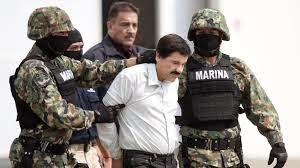
‘The Legend of Shorty’ Film to Document the Life of Mexican Drug Lord El Chapo Guzman

elchapoWill Mexican drug lord Joaquín El Chapo Guzmán become more famous now that he is behind bars than when he was hiding in secret tunnels and sewers? It’s hard to tell, but two weeks after his headline-grabbing arrest in Mexico, a new documentary about the life of this nearly mythical figure made its world premiere at the South by Southwest (SXSW) festival in Austin, Texas.

According to those who have watched The Legend Of Shorty, a 90 minute British documentary co-directed by British filmmaker Angus MacQueen and Peruvian journalist Guillermo Galdós, the film is a blend of mythology and hard facts. The Guardian’s film critic Henry Barnes wrote that The Legend of Shorty follows MacQueen and Galdós as they head out on their own investigation into the whereabouts of the world’s biggest drug dealer. “With extraordinary access to the cartel the pair travel to Mexico’s Golden Triangle, bear witness to the batch-loads of cocaine, meth and marijuana being prepared for transport and take part in long, often surreal meetings with Chapo’s inner circle, including a lunch date with his mum,” Barnes wrote.

McQueen told Spain’s Efe wire service that they didn’t think their lives were in danger when they were filming, because they are foreigners. There is a general belief that foreign nationals, whether tourists or otherwise, tend to be less physically vulnerable than Mexican nationals.

It is not clear if MacQueen and Galdós tried and failed to interview El Chapo before he was caught. In any event, the Mexican Navy and the DEA beat them to it when they found the drug lord still in bed at an oceanfront condominium in Mazatlán, Sinaloa, his home state, in the early hours of February 22. The arrest put an end to an international manhunt that has made a mockery of U.S. and Mexican law-enforcement over the past 13 years.

Barnes writes that the film’s directors recruited songwriter Jackson Scott to compose folk songs in English and Spanish telling tales about the past of one the world’s richest outlaws: “We hear how Chapo escaped from a maximum security prison by hiding in a laundry cart, we watch the film-makers compare the kingpin to Zorro, racing through the countryside, answering the call of the common man.”

In an effort to balance what appears to be a friendly portrait  of the man responsible for introducing 25% of the illegal drugs into the U.S. market –including 50% of the heroine– the film discusses the bloody war on drugs and the 80,000 deaths that have resulted from it. Mexican journalist Anabel Hernández, author of Narcoland: The Mexican Drug Lords and Their Godfathers, offers “a vital counter-point to the intoxicating legend”, as Barnes puts it, by accusing the Mexican government of protecting El Chapo while he turned his business into a word-wide criminal empire that has no precedent in history.

Barnes calls The Legend of Shorty “an impressive film” and says that El Chapo’s unexpected arrest does not annul its purpose: “To suggest so is to assume that El Chapo’s empire is locked up with the man. That a corporation shuts down because the CEO is absent.”

On that, Barnes has a point. There seems to be a wide consensus, both inside and outside Mexico, that El Chapo’s arrest will change little. “He will have a laptop, [his prison] will turn into a hotel, and he will return to running the cartel from there,” a senior DEA official told The Guardian last month. “That is not something he has to build – it is something he already has.”

Since 2009, El Chapo has been included in Forbes’ World’s Most Powerful People list.

Originally posted on Forbes.com

The Jalisco New Generation Cartel Believed To Be Mexico’s Fastest Growing Cartel

CjNG
CJNG aka Jalisco New Cartel becoming Mexico’s fastest growing drug cartel.

The town still bears the scars from the unprecedented offensive launched by a powerful Mexican drug cartel against government forces: bullet-pocked buildings and blood stains on the street.

The March 19 ambush that killed five federal gendarmerie officers, three gang suspects and three bystanders in Ocotlan signaled the start of a conflict between the authorities and the Jalisco New Generation Drug Cartel.

The well-armed gang took its operation to a new level on April 6 when it surprised a Jalisco state police convoy, gunning down 15 officers in the deadliest single day for Mexico’s security forces in years of a bloody drug war.

The western state of Jalisco is known as the birthplace of tequila, mariachis and the country’s most popular football team, the Chivas of Guadalajara.

But now it is also known as the home of the New Generation, a rising power of Mexico’s underworld that had been overshadowed until now by other groups such as the Sinaloa, Zetas, Gulf and Knights Templar cartels.

Officials say the Jalisco cartel has grown so powerful that it has produced its own assault rifles in makeshift gun assembly shops. The gang has even recruited military deserters, including foreign ones.

“They were waiting for the moment when they felt strong to start this escalation,” Luis Carlos Najera, the chief prosecutor of Jalisco state, told AFP.

Last year, authorities discovered a clandestine workshop with sophisticated equipment to build M16 and R15 rifles. Some of the homemade weapons were found following the recent attacks.

The cartel has drawn the attention of the US government, which has funded Mexico’s battle against drug cartels by providing equipment, training and intelligence.

Last week, the US Treasury Department slapped financial sanctions against the New Generation and its shadowy boss, Nemesio Oseguera, alias “El Mencho,” as well as its allies, the Los Cuinis cartel.

The gang has expanded beyond Jalisco into neighboring Michoacan and Colima while forging ties with other criminal organizations in the United States, Latin America, Africa, Europe and Asia, according to the US Treasury.

– 138 bullet holes –

The growing power of the cartel is evident in the destruction it has left behind in Ocotlan, near Mexico’s second biggest city, Guadalajara.

“My house was hit by 138 bullets,” said an Ocotlan resident who asked to remain anonymous due to safety concerns.

The woman said she and her husband laid on the floor during the March 19 shootout, which lasted nearly two hours.

That night, some 40 gunmen waited inside 12 pick-up trucks for the arrival of the convoy carrying the gendarmerie, a new elite police force launched last year by President Enrique Pena Nieto.

The gangsters fired from several sides and rooftops, according to local residents. Soldiers rushed to the scene and burst into homes to find the shooters.

People spent the night without light or telephone service because utility poles were hit in the firefight.

Two weeks later, a new ambush was launched against the state police convoy, this time on a rural, curvy road in a mountain between Guadalajara and the Pacific resort town of Puerto Vallarta.

The gang parked cars on the road to slow the arrival of reinforcements as they gunned down 15 officers.

The assailants used a Barrett anti-tank rifles and grenades against the convoy, said Jalisco security commissioner Francisco Alejandro Solorio.

[Read More] on Yahoo News