
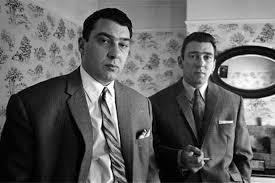
Reggie Kray 1/2 Of London’s ‘Kray Twins’ Claims His Brother Ronnie Died With No Regret For Killings

KrayTwins

Ex-gangland leader talks about the twins’ violent past.


Via The Independent:

Kray, 61, also disclosed that he and his brother, Ronnie, who died of a heart attack 11 days ago, had a “premonition” that something bad was going to happen.

The gangland leaders were given life sentences in 1969 for killing Jack “the Hat” McVitie who was knifed to death. Ronnie was also convicted of the murder of George Cornell, whom he shot between the eyes in the Blind Beggar pub in the East End of London after being called a “fat poof”.

Reggie Kray, the man whose words and deeds once terrorised the London underworld, said yesterday: “I have got no regrets, my brother didn’t have any either. I have learnt over the years, as did Ron, that there are many people worse off than us. A lot of people have no choice but we did.”

Speaking at Maidstone prison in Kent, in the first full interview since his brother’s death, he added: “I would not change anything. You can’t just select parts of your life and alter them. I know Ronnie would not have wanted to change anything as well.

“It does not mean to say that I enjoy the fact that I committed a murder but you can’t select the parts of life that you do and don’t want.”

For much of the Sixties the Krays ruled large parts of the capital through extreme violence and fear.

Kray, whose body still looks tough and hard from his daily regime of cold showers and working out in the gym, still believes – despite 27 years in jail – that the twins were not evil.

“Ron and myself wrought some violence on different people, but we lived in a violent world and violence has been perpetrated on us as well. That was the way of life in the East End of London then.

“I’ve met people inside who have become part of my family – if I hadn’t done what I did I would never have meet them. I feel I have been blessed.”

Dressed in shorts, Reebok training shoes, a blue shirt, leather waistcoat and gold jewelry, he said he had been in almost daily contact with his twin brother, who was diagnosed a schizophrenic, until the day he died. They were allowed to speak on the telephone every Thursday and wrote almost every day. “He was okay when I spoke to him last, although we had a premonition that something was going to happen,” he said.

But after being allowed out to see his brother’s body last Thursday Kray said he knew he was at peace. “Being twins there’s a certain amount of telepathy. I know he is at ease.”

He said his concerns about the possibility of foul play in his brother’s death had been resolved after he was sent the doctor’s report that showed Ronnie died of a heart attack.

He has instructed his solicitor to investigate his brother’s inquest, in which a coroner took three minutes to return a verdict of death by natural causes. Kray added: “If I’m not satisfied I will take action.”

Staff at Maidstone jail said yesterday that Kray was now a model inmate. One officer said: “He’s an elderly gentleman now. He’s as good as gold – if every prisoner was like him there would be no problems here at all.”

Jamaica’s ‘Resilience 3’ Operation Aimed At Combating Crime Since The Arrest Of The Country’s Most Powerful Crime Boss Dudus Coke

KingstonGangstersDudusCoke

The following editorial was posted on the Jamaica Gleaner and discusses the Jamaican government’s attempts to take back the streets of Kingston from criminals.

Since the bloody manhunt and conviction of Christopher Dudus Coke, government officials have vowed to clean up the streets of West Kingston which have been overtaken by gangs and drug activity.


Jamaica Defense Force launches Operation Resilience 3 to combat gang and drug activity in downtown Kingston.

Via Jamaica Gleaner:

It may have expired by now, but over the past several days, the police in the downtown/western Kingston area of the Jamaican capital have been engaged in an operation they call Resilience 3. They have had help from the Jamaica Defence Force.

The effort, according to Senior Superintendent Steve McGregor, the head of the Kingston West Police Division, is aimed at “intensifying the pressure on criminals operating in downtown, especially in the market district”. In others words, the security authorities felt that there was need for something dramatic to confront, and hopefully contain, the epidemic of extortion and violent criminality that has resurged in the western section of the city since the time, four years ago, in the aftermath of the Tivoli Gardens operation, when people felt that Jamaica, finally, was coming to grips with the problem.

The incursion into Tivoli Gardens to arrest, for extradition, the drug lord/gangster, Christopher Coke, proved to be a violent affair. More than 70 civilians were killed, although it is claimed that many of them did not die in gunfights and might have been victims of extrajudicial killings.

Shift in crime dynamics

What is clear is that the dislodgement of Coke, the country’s top crime boss, and the psychological impact of degrading his Tivoli Gardens redoubt, for a time, shifted the dynamic of crime in Jamaica. Although – at a 45 per 100,000 population – our murder rate remained extraordinarily high review, the actual number of murders declined by a third.

It is true, too, that during Coke’s iron-grip rein, there were, despite its reputation as a haven for hard men of violence, few murders in west Kingston. And there was a kind of ‘order’ to the extortion business downtown. With his departure, the law-enforcement authorities seemed to have regained control of a previously ungoverned part of the city. The extortionists disappeared.

During those early, heady days, there was a fair bit of chest-beating by the authorities, including the police, and the rest of the society was optimistic. We had hoped that west Kingston/downtown’s small geographical areas, would be sustainable models of crime management and a template for the rest of Jamaica’s high crime communities. It hasn’t held.

Four per cent increase in murders

Last year, the number of murders in Jamaica increased by four per cent, to more than 1,200. But more significant is what is happening in west Kingston. There is a factional fight among gangsters for turf. In 2014, up to the third week of May, there were already 36 murders in the division – an increase of 36 per cent. The extortionists are back in force downtown, without the old central command and control.

In a sense, Resilience 3 is an admittance by the authorities that they have lost the plot on post-Coke downtown/west Kingston. They can no longer deny the presence of the extortionists. And that has implications for crime in the wider Jamaica, to which the environment upon which containment and the possibility transformation, initially achieved in Tivoli/west Kingston, was not extended.

For example, an absence of consensus, and in the case of the current security minister, active opposition, contributed to the collapse of a state of emergency that helped to create that environment. Since then, there have been fine words and pretty documents. Hard achievements are few.

Frances Shea, Wife Of East End London Gangster Reggie Kray Described Married Life Full Of Abuse, Weapons And Constant Isolation

reggie-kray
London gangster Reggie Kray and first wife Frances Shea on their wedding day.

Reggie Kray slept with armoury of weapons by his bedside, a diary written by his late wife, Frances Shea, reveals.

Shea was married to the East End gangster for two years, before dying of an overdose when she was just 24.

She first met Kray at the age of 16 and married him in 1965 when she was 22. Her five-page diary – which was auctioned off at Gorringes of Lewes, East Sussex – highlights the difficulties with living with her then husband.

“(He) came back night time. By the side of bed gun, sword, knife, chopper, flick-knife,” she wrote.

“He used to sleep with flick-knife under his pillow.”

Also being sold are 60 letters written by Kray to Shea before they were married and while he was still in prison. The letters start as light and chatty in tone, before fast becoming controlling and aggressive.

In one he describes his future wife as a “spiteful little tormentor” after she “humiliated” him by going dancing with her friends.

Her diary describes how isolated she felt living at their Marble Arch flat, repeatedly being subjected to his swearing and drunken, abusive behaviour.

“(Reggie) came in late every night drunk. Got up every morning two minutes to dress, left me all day came back late at night drunk.

“Went to his house – his brother walked in bedroom in underwear, swore at me.

“Went back to flat Marble Arch, came back night time.”

When she complained to her brother about the Krays gun collection, she was sworn at and the stash taken away by a local publican. Eventually, she was admitted to hospital “for some rest”.

“Him and his friend took me to the hospital, he was swearing and shouting at me in the car.”

“Couldn’t stand it anymore – left him. When I was packing my suitcases to leave he told me he would bring up fictitious characters against.”

Shea tried to get their marriage annulled on the grounds that it was never consummated. Eventually, she died following a fatal drug overdose in 1967.

She was buried in the Kray family plot in Chingford, Essex, although her family unsuccessfully tried to have her exhumed and buried elsewhere under her maiden name, Shea.

reggie-kraywife
Ronnie and Reggie Kray with new wife Frances Shea in 1965.

“They had an unhappy marriage and it seems someone told Frances to write down incidents while she was trying to divorce Reggie,” said Jane Anderson, of auctioneers Gorringes of Lewes.

“It seems life with him was impossible. She spent most of her time alone in their flat and when he was there he was often drunk and he slept in a bed with various weaponry.

“When he was in prison it was safe for her to have a relationship with him.

“But on the outside, she was way out of her depth and was very frightened of Reggie, as anyone would have been.”

Ella Alexander