Three Mexican soldiers were killed Friday when members of a drug cartel opened fire on a military helicopter forcing it into an emergency landing. The authorities said that 10 more soldiers were wounded in the incident.
The government announced on May 1 the beginning of Operation Jalisco in the country’s largest state of Jalisco against the New Generation Drug Cartel, which has been expanding its reach in the province in recent months.
“I lament the deaths of the members of the Mexican military in the fulfillment of their duty in Jalisco,” President Enrique Peña Nieto tweeted.
In the state capital of Guadalajara, the cartel group also set several buses and cars on fire, torched banks and gas stations, and blocked roads in at least 20 areas across the city. The governor said that today’s attacks were a result of the announcement of the operation.
Such “narco-blockades” are a common cartel response to the arrest of important members or are used to foil police and military operations.
Luis Carlos Nájera Gutiérrez de Velasco, the state’s attorney general, described the group as the “least vulnerable, least attacked” of the major drug gangs and said the federal government has not been doing enough to help the state.
“Remain calm. If you have any reason to leave your house, don’t go out,” the Jalisco state prosecutor’s office said on Twitter as the country celebrated celebrated the May 1 holiday.
Last month, the same group killed 15 police officers in an ambush that was described as the deadliest since president Peña Nieto took office in 2012.
Under Indonesian law, the death penalty is carried out by a 12-man firing squad, although only three guns are loaded with live ammunition. Prisoners are given the choice of whether to stand or sit, and whether they want to wear a blindfold, hood or nothing.
The planned execution of nine international drug traffickers in Indonesia will move forward, despite a global outcry and a plea from the United Nations to spare their lives.
The Indonesian government gave the convicts — who are from Australia, Nigeria, the Philippines, Brazil, France, and one from Indonesia — a 72-hour warning for the executions and asked for their last wishes, a spokesman for Indonesia’s attorney general said, according to the Associated Press.
On Friday, the attorney general’s office asked the foreign embassies of the prisoners to send representatives to the maximum-security prison where the executions will take place, according to Reuters.
UN Secretary General Ban Ki-Moon joined a chorus of world leaders asking Indonesia to refrain from carrying out the execution.
“Under international law, if the death penalty is to be used at all, it should only be imposed for the most serious crimes, namely those involving intentional killing, and only with appropriate safeguards,” Ban’s statement said. “Drug-related offenses generally are not considered to fall under the category of most serious crimes. The Secretary-General urges President Joko Widodo to urgently consider declaring a moratorium on capital punishment in Indonesia, with a view toward abolition.”
Widodo has said he will not grant clemency to any drug dealers on death row, according to the New York Times.
Australian Prime Minister Tony Abbot has pleaded for clemency for Australian prisoners Andrew Chan and Myuran Sukumaran, who were convicted of of trying to smuggle 18 pounds of heroin from Bali to Sydney, Australia, in 2005.
“As a Government, as a Parliament that wants nothing but good for Indonesia, we are speaking as one united voice publicly and privately in every way we can — pull back from this brink,” Abbott said last month. “Pull back from this brink. Don’t just realize what is in your own best interests, but realize what is in your own best values.”
French President Francois Hollande said there could be diplomatic and economic consequences if Indonesia executed French citizen Serge Atlaoui, who will have a last-minute court hearing Monday.
The prisoners are to be executed by firing squad, according to the government’s statement.
Indonesia previously executed six drug traffickers by firing squad in January despite calls for leniency, and remains among the strictest nations when it comes to drug laws. According to the AP, more than 130 people are on death row in the country, mostly for drug crimes, and about a third of them are foreigners.
Indonesian Attorney General Muhammad Prasetyo said after the January executions that he hoped the strict laws would have a “deterrent effect.”
“What we do is merely aimed at protecting our nation from the danger of drugs,” Prasetyo told reporters in January, saying that 40 to 50 people die each day from drugs in Indonesia and that trafficking had spread to many remote villages in the island country, according to the Times.
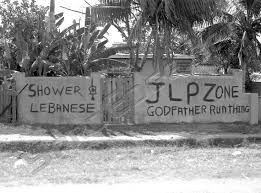
Signs marking territory within Tivoli Gardens community once ruled by The Shower Posse/ Christopher Dudus Coke. Photo: Christopher Edmonds
The chairman of the Tivoli Commission of Enquiry, Sir David Simmons made his first stop of the tour in Rasta City, an area of the Tivoli Gardens community.
Local residents there openly complained that police officers conducting the tour were not taking the chairman to the right areas of the community.
They told Simmons that Christopher ‘Dudus’ Coke left the community about 10:00 am on May 24, 2010 and then the police entered the community, firing shots at residents without justification.
The chairman was then taken through a hole in a wall where residents showed him areas where alleged police abuse took place and homes were severely damaged during the incursion.



 The Pen Hustle With Brandy Cavalli
You must be logged in to post a comment.