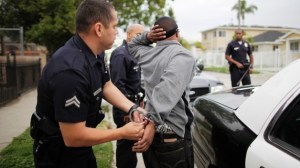
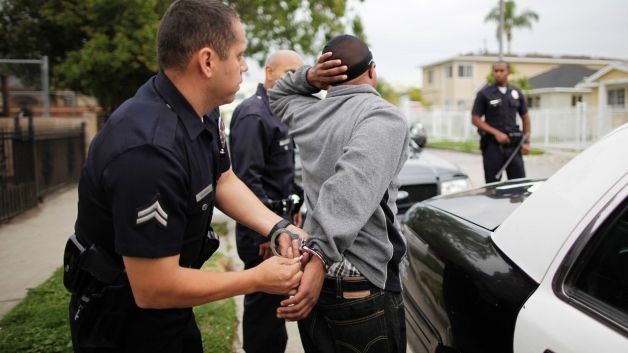
 Well here’s an absolute no brainer!
According to a comprehensive survey performed out in Connecticut, “Blacks and Hispanics more likely to be targeted, ticketed, arrested and murdered by the cops”
The real injustice here is that there is no need for a “comprehensive” survey to arrive at this conclusion.
The evidence speaks for itself…
but I’ll let you be the judge.
Join the discussion.
 The most comprehensive survey ever conducted of police stops in Connecticut continues to show that black and Hispanic motorists who commit moving violations are more likely to be ticketed than are white drivers pulled over for the same offense. –Bossip
A Courant analysis of data collected as part of the Connecticut Racial Profiling Prohibition Project shows that for the most common moving violations — speeding, traffic-light violations and stop-sign violations — black and Hispanic offenders statewide are 11 to 41 percent more likely to end up with a ticket than are white offenders stopped for the same offense.
Among more than 150,000 speeders, for example, 51 percent of white motorists stopped by police received a ticket, compared with 63 percent of black drivers and 66 percent of Hispanic drivers.
For drivers caught running a stop sign, 29 percent of white drivers were given a ticket for the offense, compared with 34 percent for blacks and 41 percent for Hispanics.
The disparity was stark for a variety of equipment-related issues as well, including defective lights, license-plate problems and tinted windows. For equipment violations collectively, white drivers were ticketed in 9 percent of stops, while blacks and Hispanics were ticketed in 15 percent and 18 percent of stops, respectively.
Douglas Fuchs, the police chief in Redding and a past president of the Connecticut Police Chiefs Association, warned that a statewide analysis of post-stop data does not give a true picture of policing in Connecticut.
“There’s so many different factors that one has to take into account, that the only really fair way to do this analysis is ultimately to drill down to the officer level,” Fuchs said. “Absent that level of analysis, there’s too many anomalies, there’s too many policies, there’s too many rates at which we police differently to look at anything as a whole.”




 The Pen Hustle With Brandy Cavalli
You must be logged in to post a comment.