
60 Year Old Massachusetts Mother Charged With Operating A Crack-Cocaine Delivery Service From Her Pickup Truck

donnamcleod
60-year-old Donna McLeod was arrested for allegedly running a crack cocaine delivery service from the cab of her pickup truck.

With her adult children watching from the gallery, Donna M. McLeod, of Springfield, pleaded innocent to cocaine trafficking between 18 and 36 grams during her arraignment in Springfield District Court.
She also denied a charge of possessing ammunition without a firearms identification card.

McLeod, was arrested Monday morning when Springfield police raided her apartment and seized 46 grams, or about 1.6 ounces, of crack cocaine packaged for sale, Assistant District Attorney Jill O’Connor said.

They also found $407 in cash, several cell phones and two bullets inside a knapsack, O’Connor said.

The defendant was seen making deliveries across Springfield in a green Ford pickup truck, the prosecutor.

To set up deliveries, customers “would contact her by cell phone,” O’Connor said.

The cell phones continued ringing as detectives searched the apartment, according to the prosecutor, who said extensive surveillance and several controlled buys were conducted before the raid.

O’Connor asked for $25,000 bail, citing several drug convictions on McLeod’s record, including a 2005 trafficking charge that resulted in a three-year prison sentence.

Defense lawyer Erin Boylan asked for $2,000 bail, explaining that the defendant poses no flight risk and has shown up for court hearings in the past.

A mother of four children, McLeod is also a caretaker for her sister, who was disabled by a stroke and suffers from cancer, among other maladies, Boylan said.

The defendant’s last crack cocaine conviction was ten years ago, Boylan said.

As for the two bullets found in the backpack, they were keepsakes from a military funeral, the lawyer said.

Judge William Rota set bail at $10,000.

Original article posted on MassLive
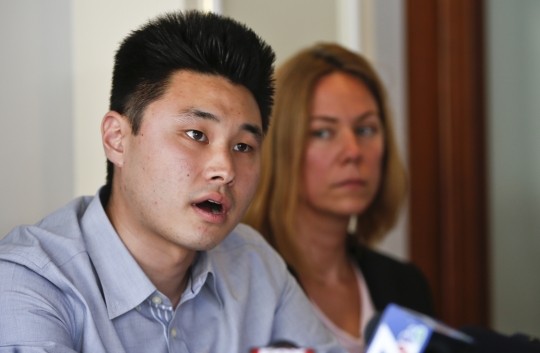
DEA Can’t Tell Senate How Detained Student Was Left to Drink Own Urine to Live

chongDuring an obscure Senate hearing on Tuesday morning, lawmakers vented their frustrations with the Drug Enforcement Administration for failing to answer questions about an incident that saw a man almost die of dehydration while in its custody.

“At what point do I have to conclude that the [Drug Enforcement Administration] is hiding something about what happened here?” asked Sen. Chuck Grassley, R-Iowa, unsuccessfully prodding a DEA witness to explain why Senate inquiries into what happened to Daniel Chong have been met with silence.

On April 20, 2012, Chong was detained by DEA agents during a drug raid on a friend’s house in San Diego. The 23-year-old university student cooperated with agents during an interrogation, and was told that he would soon be free to go, only to be handcuffed with his hands behind his back and left in a small holding cell for five days without food or water. When he was finally discovered, Chong was suffering from near-kidney failure and hypothermia and in need of serious medical attention.

A Justice Department Office of Inspector General (OIG) investigation released last June shed additional light on Chong’s maddening de facto sentence — often served in complete darkness. He told investigators he was forced to drink his own urine and at one point attempted suicide.

Chong later received a $4.1 million settlement from the Justice Department.

The inspector general’s report, however, raised new questions about the incident, and cast doubt on DEA agents’ claims that they didn’t hear Chong’s repeated shouts and bangs in a bid to get someone’s attention. When his version of events was recreated for the purposes of the probe, an investigator “clearly heard the banging and yelling.”

Senator Grassley, who called the findings “shocking,” had last August sent a 19-question letter to DEA administrator Michele Leonhart.

“It’s been now eight months — I still don’t have a response from DEA to these questions,” Sen. Grassley said on Tuesday. He asked DEA Deputy Assistant Administrator of Drug Diversion Joseph Rannazzisi to commit the agency to responding to his inquiry by the end of the month.

Rannazzisi responded that “This was a regrettable tragic event,” before admitting that “I can’t speak for DEA or the department when the letter is going to come to you.”

Also lamenting the agency’s lack of transparency was Sen. Dianne Feinstein, D-Calif. Her office sent two unanswered letters to the DEA last year in July and August seeking answers about the detention of her constituent.

“When we don’t get responses to our letters, that colors our view of the agency — particularly when we’re writing about a constituent who suffered from a real lapse in process,” Sen. Feinstein said during the hearing.

On Tuesday the Los Angeles Times revealed that the most severe punishment meted out to the agents responsible for Chong’s nightmare was a seven-day suspension.

“It blows my mind,” Sen. Feinstein said during the hearing, referring to the leniency afforded to the agents who were involved in what she described as a “serious infraction.”

Written By Sam Sacks

fightingtyranny's avatarFTSN Autodesk

You would think that after three years the DEA would have figured out why they dumped an innocent man in a cell and then forgot about him for five days.

The post DEA Can’t Tell Senate How Detained Student Was Left to Drink Own Urine to Live appeared first on The Intercept.

from The Intercept http://ift.tt/1bvKB45
via IFTTT

View original post

Prison Labor Booms In US As Low-Cost Inmates Bring Billions

US breeds a Chinese-style inmate labor scheme on its own soil. Both state and some of the biggest private companies are now enjoying the fruits of a cheap and readily available work force, with tens of millions of dollars spent by private prisons to keep their jails full.

prisonworkdetail

fightingtyranny's avatarFTSN Autodesk

from WHAT REALLY HAPPENED http://ift.tt/1IKzlhM
via IFTTT

View original post