
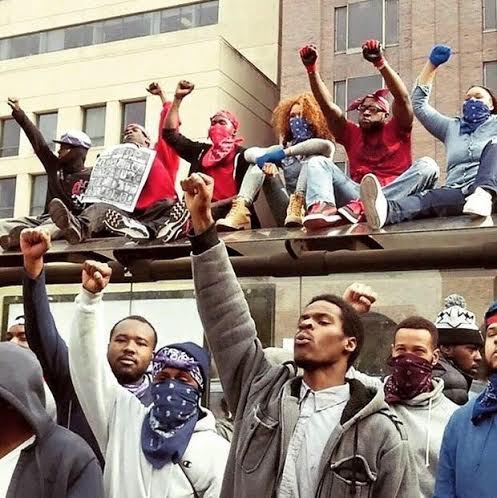
What a beautiful sight to behold.
In the wake of the Baltimore uprisings, rival gangsters put down their guns and flags to foster unity and stand against police brutality.
The public display of unity between urban gangs is definitely a positive step in the right direction. It feels good to see togetherness among young black youth and adults during these times in which racial division and tension has reached its climax.
As an African American woman, it disturbs me deeply every time I hear of news of another unarmed black man being killed by police, but as a “realist” I understand that there is a deeper underlining issue at hand. We as a race must set a better example, and in order to demand respect and true equality, we MUST first respect our own.
A Twitter post that I ran across rang true:
“Police will not stop killing black men until black men stop killing black men”.
Hopefully more unity (and less violence) among gangs will help to promote positive changes within black communities and help re-invent how blacks and minorities are viewed by law enforcement, the judicial system and –possibly the world.
It is an effort that must be put forth by us all.
#BlackLivesMatter #AllLivesMatter

Several photos purportedly showing members of the usually warring gangs posing together have been shared on social media, in an alliance apparently brokered by the Nation of Islam activists in honour of Freddie Gray, who died of a spinal injury while in police custody and whose funeral served as the catalyst for the riots.
One photo sees men in red bandanas sitting next to men in blue bandanas with their fists in the air, while a video shows members of each gang with their arms around each other explaining that they’ve put their differences aside because they don’t want people to get hurt.
“I can say with honesty those brothers demonstrated they can be united for a common good,” said Carlos Muhammad, a minister at Nation of Islam’s Mosque No. 6. “At the rally, they made the call that they must be united on that day. It should be commended.”
“We can unite and stop killing one another,” he added to The Daily Beast, “and the Bloods and the Crips can help rebuild their community.”


 The Pen Hustle With Brandy Cavalli
You must be logged in to post a comment.