Buckhead (Atlanta) tastemaker Danielle Rollins, author of “Soirée: Entertaining with Style”
Buckhead tastemaker Danielle Rollins, author of “Soirée: Entertaining with Style” and recently named one of “The Salonniere’s” 100 best party hosts in America, survived a bold home-invasion attempt this weekend at her Buckhead house. “I’m obviously rather freaked out and tired, but I’m not going to be scared out of my own house,” she told the AJC newspaper.
Rollins was unpacking the night after Christmas, after a holiday break, when someone tried to enter her home.
She shared the following message on her Facebook account:
The private security guard I hired after my last break-in three weeks ago, and probably for the rest of my life now after this, chased at least two men through a neighbor’s yard. They dropped a backpack containing items including but not limited to guns, mace and ties. The (Atlanta) Police Department responded immediately, blocking and securing the area, with helicopter and canine patrol. This is not a way to live.
Read more about this story as well as the robbery of Buckhead high end events planner Toni Moceri in which she was held at gunpoint for 90 minutes. AJC.com
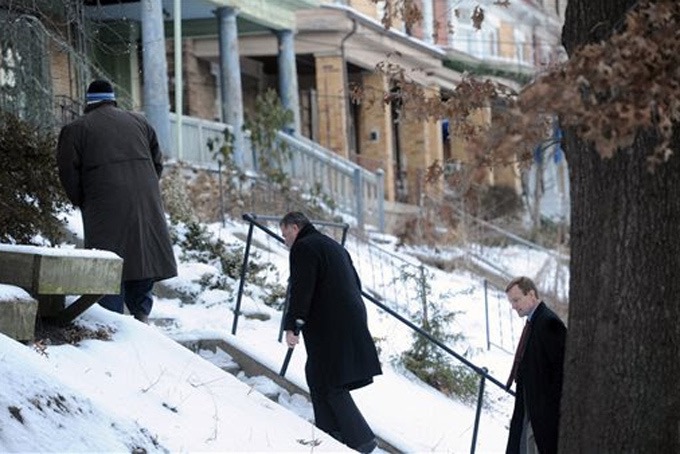
This Feb. 7, 2014, photo shows authorities outside a home on Chislett Street in Pittsburgh. The bodies of sisters Susan Wolfe and Sarah Wolfe were found in the basement of their home on Chislett Street. (AP Photo/Pittsburgh Post-Gazette, Rebecca Droke) Pittsburgh (AP)– Almost two years after two sisters who had just moved to Pittsburgh were found shot to death in the basement of their East Liberty home, the two-story, 2,200-square-foot house on Chislett Street stands vacant, padlocked and under the control of a bank that has foreclosed on it.
No one has lived in it since the double homicide occurred there in February 2014 and neighbors still are wary of discussing how memories of the tragic event have affected the neighborhood.
When a murder_ or even a natural death _occurs inside a home, it can traumatize a neighborhood. Beyond that, it can create a significant and understandable challenge when it comes time to sell.
The effect is exacerbated when the death is a highly publicized event. Not only is the home itself affected but, according to personal finance comparison website Finder.com, homes within a four-block radius can lose tens of thousands of dollars in value up to a year after the homicide takes place. It’s a delicate issue for both home buyers and sellers.
Finder.com estimates the U.S. housing market lost $2.3 billion in value in 2014 due to homicides. Pennsylvania homes with a median value of $150,000 lost an average of $5,909 due to 609 homicides that year. The Pittsburgh area, which had 71 homicides in 2014, is estimated to have lost an average $4,646 in home value in areas where homicides occurred.
“There is a psychological factor,” said Fred Schebesta, CEO of the Santa Monica-based website. “The psychological distress of a homicide in a home or an area tends to affect its desirability.”
Some high-profile examples Finder.com used to illustrate the point included Nicole Brown Simpson’s California condo selling for $200,000 less than its market value due to publicity it received during the O.J. Simpson trial; and the Boulder, Colo., house where JonBenet Ramsey died selling for nearly $1 million less than comparable homes in the area after languishing on the market for two years.
Another local example of a murder destroying the value of a home includes the Stanton Heights property where three city police officers were ambushed and killed after responding to a domestic violence call in April 2009. The house on Fairfield Street where the killings took place had gone into foreclosure and was demolished a year and a half later, to the relief of neighbors who saw the boarded-up house as a constant reminder of that horrible day.
Schebesta said his company conducted the study because he felt, given the decrease in property value for homes stigmatized by homicide, they could be an investment opportunity for those willing to take the risks.
“Smart investors will be attracted to those properties,” he said. “They are able to pay less than what they should, and eventually people will forget about the murder and the neighborhood will clean up.”
Pittsburgh real estate agent Mike Netzel said there also tends to be a stigma attached to homes in which someone has died, even if that person passed away peacefully.
“I have worked with people before who have specifically asked that they not buy a home where someone has passed away,” said Netzel, an agent with Keller Williams Realty who services the North Hills. “The challenge is that we have a lot of older housing stock. We can ask the current owner if someone has passed away in the home, but there is no way of knowing if that is the case for previous ownership.
“Some people will look at a cemetery adjacent to a house as a peaceful setting,” Netzel said. Personally, it doesn’t bother me, but it’s a completely personal decision where I have not found anyone ambivalent. It either is a non-factor or an absolute deal breaker.”
According to Pennsylvania law, real estate agents and sellers are not required to inform potential buyers if a homicide has occurred in a house, but if they are specifically asked, they must provide a truthful answer.
Hank Lerner, an attorney for the Pennsylvania Association of Realtors in Harrisburg, said a 2012 case decided by the state Supreme Court, a case known as Milliken vs. Jacono, determined that only material defects_ such as roofing or plumbing problems _must be disclosed, and a psychological defect is not a material defect of real estate.
The Milliken vs. Jacono case involved a murder/?suicide at a suburban Philadelphia house in 2006. A buyer who moved from California with her two children paid $610,000 for it and learned of the event from a neighbor a few weeks later. She filed a complaint against the sellers and the real estate agent for not disclosing the tragedy. She claimed she would never had bought the house had she known.
The court’s rationale in deciding against her was that the varieties of traumatizing events that could occur at a house were endless and that efforts to define those warranting mandatory disclosure would be a “Sisyphean task.” Death by poisoning or overdose and violent crimes such as rape, assault, home invasion, child abuse and even satanic rituals were all examples considered by the court.
In the case of the East Liberty home on Chislett Street, the house is under the control of the Federal Home Loan Mortgage Corp., a government lender in McLean, Va., according to the Allegheny County real estate website. A recent visit found the lawn overgrown and a sign on the window saying the house had been winterized and warning not to attempt to use any water.
Although the house was featured in many news reports, news organizations often avoid giving an exact address of homes where homicides and other serious crimes have occurred. In situations like that one, potential buyers might have to do some research on their own to learn the home’s history.
“What we find in the market today is many buyers will Google the address to find out about a house or an area,” said Lerner. “A Google search will usually pop a red flag. An agent may not be at liberty to discuss an incident. But they cannot lie. And there are other ways for a buyer to find out.
“We often talk about risk management techniques,” he said. “Many sellers may decide to disclose a psychological defect to avoid litigation down the road.”
Joe Calloway, owner of Allentown-based RE360, was the largest buyer of investment property in the city of Pittsburgh in 2013. He said in his experience he has found that safety and superstition are both factors that come into play with homes where any type of death violent or non-violent has occurred.
“Death is an eerie subject,” Calloway said.
“People fear death and don’t want to be near it. The same goes for cemeteries. Houses located near or within view of a cemetery will often have lower value than neighboring houses that do not.”





You must be logged in to post a comment.