
Brazilian Woman Becomes Drug Cartel Boss After Sold Into Sex Slavery

Raquel Oliveira headed a violent drug organization in the Brazilian slum of Rocinha in Rio de Janeiro during the late 1980s. Via Facebook

Child prostitute. Brutal drug cartel leader. Cocaine addict. Popular author.

That’s the unlikely path taken by Brazilian woman Raquel Oliveira, a former cocaine boss in the Brazilian slum of Rocinha in Rio de Janeiro.

“If you ask anyone here if I was a bandida [drug dealer], they will say yes,” Oliveira, in her 50s, told Vice. “People still respect me.”

It wasn’t always that way: when Oliveira was just a child, her grandmother sold her to a gang member who forced her to work in a brothel, The Daily Mail reported.

Oliveira, who details these events in the new semi-autobiographical novel A Número Um, wouldn’t see freedom from that life until she turned 11.

That’s when the gang member gave her a gun, setting her down a violent path.

Oliveira told the Mail that she made her first kill when she was 15 when a man tried to rape her.

“To kill a man aged 15 meant nothing,” she told the Mail. “The guy wanted to rape me.”

According to Vice, Oliveira led the organization after the 1988 death of Ednaldo de Souza, the organization’s leader and her lover, during a shootout with police.

The news outlet reported that Oliveira soon became a cocaine addict, but became disenchanted with her murderous and addictive lifestyle — leading her to quit in the early 1990s and seek therapy.

This year, Oliveira published A Número Um, the first in a planned trilogy based on her experiences.

A Facebook page associated with Oliveira appears to show significant crowds showing up to book signings and readings.

“I don’t think I could have done anything better. There were no alternatives. I had nothing, I knew nothing,” Oliveira, a mother of three, told the Mail. “I’m even impressed with things I’m learning today that are things I should have known a long time ago.”

Mexican Man Denied U.S. Visa Because Of Tattoos 

  
Via Bossip– Ruben Zamora, a Mexican man who lived in the U.S. since he was 8 years-old, left the country last summer and has yet to return because of a tattoo he got in his teens. 

The American Consulate said he has gang tattoos — and, therefore, was part of a criminal enterprise according to The NY Daily News. 

Zamora, who has an American wife and 2 children thought he was doing the right thing by going to Mexico and applying for a visa but his plan backfired.
Here is what Zamora’s wife, Vanessa Ruiz had to say to The NY Daily News:

Ruiz said her husband was being condemned because of a youthful mistake.

Zamora got the tattoos when he was a teen living in Queens — and the symbols weren’t gang-related back then.

“He and his friends . . . thought that tattoo looked cool and they got it,” said Carr.

The group later got involved in gang activity, but Zamora was no longer hanging with them, the lawyer said.

“The fact is there’s no flexibility to actually look at his record and say, ‘Look, there’s been no arrests in the United States for him being in gangs,” she said. “There’s no flexibility in the law.”

For Ruiz, the thought of life without her husband is devastating — financially and emotionally.

“He was very responsible. He used to pay all the bills . . . I (am) so frustrated because I had to pay all these bills. I was going to lose my apartment. I had to go to welfare to see if they could help in some way,” said Ruiz, who works part-time in the call center at St. Barnabas Hospital in the Bronx.

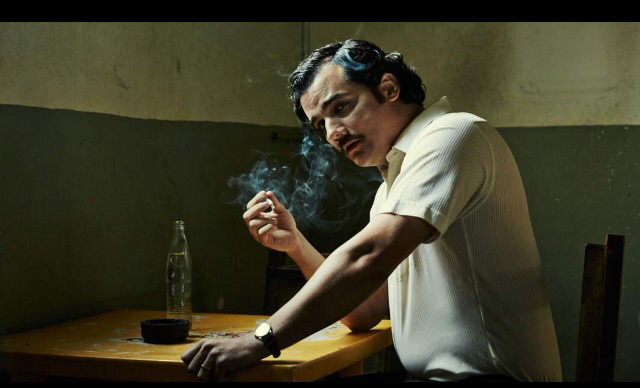
17 Facts About Narcos And The Drug Lord Who Inspired It All

  
1. Narcos was originally supposed to be a full-length feature film. According to Producer Eric Newman, once they started discussing how in-depth they wanted to get with the backstories of both the good and the bad characters, the team knew there would be way too much content for a movie. The story was just too good. It needed to be a series.

2. Brazilian actor Wagner Moura had to learn Spanish for the role of Pablo Escobar. He fully immersed himself in the character by taking a Spanish class at a local university and reading everything that had ever been printed about Pablo Escobar.

3. Moura also gained 40lbs to play Escobar—and even after that, he had to wear a fake stomach to really nail Escobar’s physique. Director José Padilha explained that Escobar himself was smoking marijuana all day and would literally eat everything in sight. His physical appearance needed to reflect his life of absurd luxury.

4. The production team was very specific about not depicting the drug war in just clearcut black and white, or good versus bad. Moura explicitly stated that the intention was never to make a show that depicted the “good American cops” going to a Third World country to save everyone.

5. Director Padilha admits that Goodfellas was a big inspiration for how he envisioned the final outcome of the series.

6. Since the actual Escobar documented himself so thoroughly, there were loads of photos and archived video footage to consult for costume recreation and inspiration throughout production of the show.

7. Escobar had to invest in $2,500 worth of rubber bands per month, just so he could hold all his cash together (seriously).

8. Roughly 10% of the cash Escobar kept hidden was eaten, each year, by actual rats. The total amount is in the billions. It made next to no difference to his overall wealth.

9. He even purchased a jet specifically to fly and transport his cash.

10. Escobar was making so much money so quickly that it’s been said he literally set fire to and burned a pile of $2 million to keep his daughter warm while they were on the run.

11. Escobar’s home, Hacienda Napoles, which is featured on the show, was built on 5,000 acres of land. It included a zoo, which, even after the property fell to ruins, was occupied by at least 20 hippos.

12. Escobar’s greatest fear was being extradited to the United States. He was terrified of spending the last years of his life in an American jail. He even offered to pay Colombia’s debt in an attempt to change the extradition laws—only about $10 billion.

13. By the end of the 1980s, Escobar was in control and supplying 80% of the world’s cocaine. Approximately 4 out of 5 Americans doing cocaine were snorting lines supplied directly by Escobar.

14. In 1989, Escobar was listed as the 7th richest man in the entire world.

15. Escobar was directly responsible for upwards of 4,000 deaths, including 200 judges, 1,000 police workers, journalists, and government officials.

16. At the same time, Escobar spent millions on renovating parks, schools, stadiums, and hospitals throughout Colombia. That’s how he got his nickname “Robin Hood.”

17. Escobar’s son (also portrayed on the show) changed his name from Juan Pablo Escobar to Sebastián Marroquín and wrote a book about his father. As far as his father’s legacy goes, Morroquîn’s says that Escobar was “very far from being a hero—I always say if someone reads my book and wants to be Pablo Escobar, then I did a bad job.” 

Source | Thought Catalog