
French Gangster Wife Turned Author: Elina Feriel

  
Elina Feriel is a 34-year-old author and former ‘gangster’s wife’, whose first book is causing a stir in France.

Feriel has appeared in the French press in recent days promoting her first book “Au bout de la violence” (After the Violence).

It’s a memoir of her years as the self-confessed wife of a drug dealer and career criminal in the violent and poverty-stricken northern district of Marseille, France’s second-largest city.

Over the course of just a few years, Feriel lost the three most important men in her life to violent crime.

Her husband, her older brother, and her new partner were all shot dead on the streets of Marseille in gangland killings.

Feriel is only just emerging in the French psyche now, but she’s already making an impression.

Her story – guns, drugs, bling, young love and the pain of repeated tragedy – is a fascinating one.

But it’s her personality as much as anything else which is making her a favourite on TV and radio talk shows.

Feriel is brutally honest and very passionate. She is critical of failures among her own people – the Arab community in Marseille – but scathing about the ignorance and hypocrisy of France’s Parisian establishment, which in her view claims to care about Marseille’s monumental problems, but actually does little to help.

She grew up in the northern district of Marseille, with an absent mother and an alcoholic father. “I was raised by the streets. I used to go around like a little boy,” she told France Info radio.

A distracted trouble-maker at school, Feriel married her husband Sabri when she was still in her late teens. She had fallen for his rough charm, and the two quickly started a family of three children.

He showered her with expensive gifts, the proceeds of his drug-dealing, but as Sabri rose through the ranks to become a top gangster in the city’s northern district, his paranoia and abusiveness increased.

Living in constant fear, Sabri began to beat Feriel, and their life spiralled out of control until he was finally shot down with a machine gun while riding his scooter.

Then, incredibly, Feriel’s older brother, who had been convicted of a bag-snatching, as well as her new partner Sam, who was “in with a bad crowd”, were both shot dead over the next few years.

Feriel says her book is not the start of a career in politics, but just to “get things off her chest.”

I’m not an activist or a spokeswoman…I just felt the need to write this to get things of my chest. It’s crucial. And if it helps to change things, all the better. 

she told Elle magazine.

After everything that has happened, Feriel has moved “far away” from Marseille’s northern district, and lives with her three children.

Feriel is sharp, witty, and very sassy. It’s clear there is some hurt, and even bitterness behind her words.

However, with the writing and publication of her memoirs, she gives the impression of someone who is prematurely wise and eager to share what she has learned (the hard way) about poverty, violence, and the allure of glamour.

After the death of my husband, some people would have preferred if I just stuffed myself full of Prozac and shut myself off in silent mourning. But I’m a bigmouth, and I do the opposite of what people expect from me. 

she told Elle magazine in a recent interview.

I try to pass down to my children an open-mindedness, and a trust that didn’t exist where I came from. But I also want them to toughen up, and to know that the world that’s out there waiting for them, it’s not all Care Bears.

Source | The Local (France)  

Original Publication Date: March, 2013 
Is Amazon’s Brick-and-Mortar Store A Facade For E-Commerce?


Experts think the company intends to sell more than hardcovers, paperbacks, and Kindles at its retail location.
 
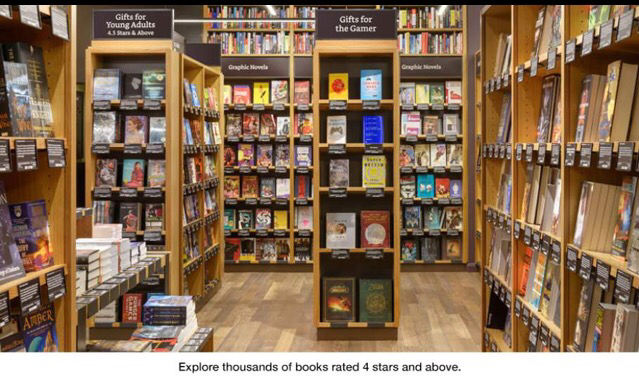
Amazon has launched a new brick-and-mortar bookstore, but did it actually leave its heart in the web?
Dubbed Amazon Books, the new retail store is open at University Village in Seattle. 

In an announcement on Tuesday, Amazon Books vice president Jennifer Cast called the store “a physical extension of Amazon.com,” adding that the company has used the knowledge it’s gained over the last two decades about consumer tastes to create a desirable in-store shopping experience.

“The books in our store are selected based on Amazon.com customer ratings, pre-orders, sales, popularity on Goodreads, and our curators’ assessments,” Cast wrote in the announcement. “These are fantastic books! Most have been rated 4 stars or above, and many are award winners.”

Read more on Fortune 

Michelle Obama Writes Powerful Editorial for The Atlantic: “Let Girls Learn”


United States First Lady Michelle Obama Photo: FirstLadies.Org
 
First Lady Michelle Obama advocate for young women and girls across the globe with today’s frank and forthright editorial in The Atlantic magazine entitled “Let Girls Learn.” 

That is also the title of her initiative with President Obama, which is aimed at doing just that. 

The program will not only fund leadership camps and address resource limitations, but it will also educate girls in conflict zones and address broader cultural beliefs that prevent girls from growing up to be successful, independent women.

Michelle Obama’s heartfelt editorial piece:

Right now, 62 million girls worldwide are not in school. They’re receiving no formal education at all—no reading, no writing, no math—none of the basic skills they need to provide for themselves and their families, and contribute fully to their countries.

Often, understandably, this issue is framed as a matter of resources—a failure to invest enough money in educating girls. We can solve this problem, the argument goes, if we provide more scholarships for girls so they can afford school fees, uniforms, and supplies; and if we provide safe transportation so their parents don’t have to worry that they’ll be sexually assaulted on their way to or from school; and if we build adequate school bathrooms for girls so they don’t have to stay home when they have their periods, and then fall behind and wind up dropping out.

And it’s true that investments like these are critical for addressing our global girls’ education crisis. That’s why, last spring, the president and I launched Let Girls Learn, a new initiative to fund community girls’ education projects like girls’ leadership camps and school bathrooms; educate girls in conflict zones; and address poverty, HIV, and other issues that keep girls out of school.

But while these investments are absolutely necessary to solve our girls’ education problem, they are simply not sufficient. 
Scholarships, bathrooms, and safe transportation will only go so far if societies still view menstruation as shameful and shun menstruating girls. Or if they fail to punish rapists and reject survivors of rape as “damaged goods.” Or if they provide few opportunities for women to join the workforce and support their families, so that it’s simply not financially viable for parents struggling with poverty to send their daughters to school.

Scholarships, bathrooms, and safe transportation will only go so far if societies fail to punish rapists and reject survivors of rape as “damaged goods.”
In other words, we cannot address our girls’ education crisis until we address the broader cultural beliefs and practices that can help cause and perpetuate this crisis. And that is precisely the message I intend to deliver this week when I travel to the Middle East. 
I’ll be visiting girls at a school in Jordan—one of many schools in that country educating both Jordanian children and children whose families have fled the conflict in Syria—to highlight the power of investments in girls’ education. But I’ll also be speaking at a global education conference in Qatar where I’ll be urging countries around the world to both make new investments in girls’ education and challenge laws and practices that silence, demean, and brutalize women—from female genital mutilation and cutting, to forced child marriage, to laws that allow marital rape and disadvantage women in the workplace.

We know that legal and cultural change is possible because we’ve seen it in countries around the world, including our own. A century ago, women in America couldn’t even vote. Decades ago, it was perfectly legal for employers to refuse to hire women, and domestic violence was seen not as a crime, but as a private family matter. But in each generation, brave people—both men and women—stood up to change these practices. They did it through individual acts like taking their bosses to court, fighting to prosecute their rapists, and leaving their abusive husbands—and through national movements and legislation that brought changes like the 19th Amendment, Title IX, and the Violence Against Women Act.   

Cultural shifts like these can spur countries to make greater investments in girls’ education. And when they do, that can cause a powerful ripple effect that can lead to even greater cultural and political progress on behalf of women. Girls who are educated marry later, have lower rates of infant and maternal mortality, and are more likely to immunize their children and less likely to contract HIV. Educated girls also earn higher salaries—15 to 25 percent more for each additional year of secondary school—and studies have shown that sending more girls to school can boost an entire country’s GDP.

And when educated girls become healthy, financially secure, empowered women, they’re far better equipped to advocate for their needs and aspirations, and challenge unjust laws and harmful practices and beliefs. So really, this can be a virtuous cycle.

But ultimately, for me, this issue isn’t just about politics or economics—for me, this is a moral issue. As I’ve traveled the world, I have met so many of these girls. I’ve seen firsthand that every single one of them has the spark of something extraordinary inside of them, and they are so hungry to realize their promise. They walk for hours each day to school, learning at rickety desks in bare concrete classrooms. They study for hours each night, holding tight to their hopes for the future, even in the face of heartbreaking odds.

We should never have to accept our girls having their bodies mutilated or being married off to grown men as teenagers.

These girls are no different from my daughters or any of our daughters. And we should never have to accept our girls having their bodies mutilated or being married off to grown men as teenagers, confined to lives of dependence and abuse. We should never have to raise them in societies that silence their voices and snuff out their dreams. None of us here in the U.S. would accept this for our own daughters and granddaughters, so why would we accept it for any girl on our planet?

As a first lady, a mother, and a human being, I cannot walk away from these girls, and I plan to keep raising my voice on their behalf for the rest of my life. I plan to keep urging world leaders to invest in their potential and create societies that truly value them as human beings. I plan to keep reaching out to local leaders, families, and girls themselves to raise awareness about the power of sending girls to school. And I plan to keep talking about this issue here at home, because I believe that all of us—men and women, in every country on this planet—have a moral obligation to give all of these girls a future worthy of their promise and their dreams.