
Diary Of Dudus Coke Gang Leader Read In Court: “This Is A Wasted Life”

  
The Tivoli Commission of Enquiry yesterday heard compelling testimony of how a notorious gangster who, amid his confessed acts of criminality, appeared remorseful about his criminal lifestyle and who was missing the affection of his family.

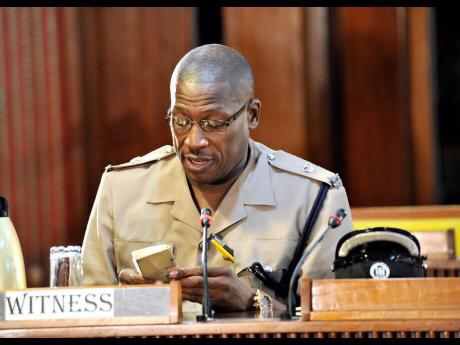
The testimony by Superintendent Beau Rigabie was based on the contents of a diary he said was penned by slain Stone Crusher gang leader ‘Doggie’ – given name Cedric Murray – who was killed in a shoot-out with the police in Clarendon on August 12, 2010.

Reverence For Coke

Several entries in the diary show the reverence Murray had for drug kingpin Christopher ‘Dudus’ Coke and the Coke clan and how he boasted about being among heavily armed thugs who waged fierce gun battles with members of the security forces during the May 2010 police-military operation in Tivoli Gardens.

In one entry dated May 24, 2010 – the day the operation was launched – Murray described how “gunshot rang out from every corner of west Kingston” and suggested that Coke and his cronies might have underestimated the firepower of the security forces.

All hell broke loose, more than we expected. I fired my AK [47 rifle] until my finger numb. I eat gun powder until my throat sore,” Rigabie said as he read one of the gangster’s boasts.

“It was a raging gun battle, a day I won’t forget and such tragedy for Jamaica. They came in and slaughter all those people to catch one man and still didn’t,” he continued.

“I escaped … one of the last from where I was … under crazy gunfire, but God, grace [and] mercy brought me out untouched and my don is free. I will always say ‘Jim Brown’ [Coke’s late father Lester Lloyd Coke] … I am loyal to the Coke family and my guns will always be ready,” Murray also wrote.

Despite this, the reputed gang leader showed his softer side in an entry he made in June 2010. Murray wrote that his heart was in pain because he was about to “lose his baby”, a reference to his female companion.

“This is just too much, she lives in constant fear. Every sound frightens her so the time has come for me to, once again, to feel the pain of being heartbroken,” he wrote.

Murray also wrote of his daughter’s fourth birthday when she reported waking up to a curfew. “I called her and she said ‘daddy soldiers’ and she was afraid. My life is filled with ups and downs,” he noted.

He also indicated that the dismantling of Coke’s west Kingston stronghold forced him “back in the streets” and that he was “very unhappy and lonely”.

Murray recounted one instance when a false alarm caused him to flee his place of hiding.

“So many of those, this is a wasted life. I don’t even have a roof over my head, I’m all over [the place]. I miss my kids,” he wrote.

Source | Jamaica Gleaner 

4000 Rounds Of Ammunition Found At The Office Of Dudus Coke 

  
As the Tovoli Enquiry resumed today, a soldier today testified that his team found 4000 rounds of ammunitions in a car in front the Presidential Click headquarters of Tivoli Gardens don Christopher ‘Dudus’ Coke.

Major Marlon Kennedy said the rounds were the largest found in the operation and appeared to be a resupply point for gunmen opposing the security forces, which had a warrant for Coke’s arrest in May 2010.

The rounds – those of AK 47, M16 and 9mm – were kept in bottles, bags, and a wash pan in the vehicle.

Kennedy also testified that one of the men from his company had been shot in the hand during the operation and is now restricted to administrative duties at the Jamaica Defence Force headquarters in Kingston.

Source | Jamaica Gleaner 

Soldiers Came Under Heavy Fire From Dudus Coke Gunmen, Major Testifies


Jamaica Defence Force (JDF) Major, whose unit was responsible for helping to place a cordon around Tivoli Gardens in May 2010, testified yesterday that it is plausible that then ‘area don’ Christopher ‘Dudus’ Coke could have escaped the community through his sector.

Major Kevron Henry was responding to questions from Tivoli Enquiry commission member Professor Anthony Harriott when he said that Coke could have slipped out of the community because his unit had faced difficulties closing the cordon due to intense resistance from gunmen.

During earlier evidence, Henry had said that the gunfire was so intense that it took his unit three hours to move a distance of 500 metres.

he major, whose unit was also tasked with the responsibility of preventing gunmen outside of Tivoli Gardens entering the community, gave evidence that 16 bodies were found in his sector which covers Denham Town and the Coronation Market.

And in response to questions from Lord Gifford, who is representing the Office of the Public Defender, Henry said that none of the men with him reported shooting anyone.

The commission is looking into the circumstances surrounding the death of 73 people during the operation to apprehend Coke, who was wanted by the United States at the time.

The commission is also looking into how Coke could have escaped the community. Coke was apprehended in late June 2010 while travelling in the vehicle of Rev Al Miller. He said he was on his way to the US Embassy in Kingston to surrender himself.

Yesterday, Henry told the professor that his unit arrived at Pechon Street at 11:00 am and never gained immediate control of the area. He said it wasn’t until 4:00 pm that his unit took control of Foxy’s Plaza from gunmen.

Questioned by commission Chairman Sir David Simmons on Coke’s escape, Henry said it was plausible he left the area on foot or in a motor vehicle.

Earlier, during his examination-in-chief led by JDF attorney Linton Gordon, Henry spoke of heavy gunfire from gunmen that kept them pinned down on the roof of Foxy’s Plaza. He said his unit was also fired on from the high-rise buildings in Tivoli Gardens and that criminals fired on a helicopter that came to conduct reconnaissance. Videos of them being pinned down in Foxy’s Plaza were also played for the commission.

He said his unit was still under fire the following day.

Henry told Jamaica Constabulary Force attorney Deborah Martin that he had never seen such coordinated attacks by gunmen.

He said the gunmen appeared “well prepared” for the offensive by the security forces.

At one point, he gave evidence that the gunmen were driving his unit into a “kill zone” with strategic gunfire and that sections of roads were blocked.

The JDF Major testified that a number of grenades, explosives and various makes of weapons were found during a search after the operation. He described Chestnut Lane in West Kingston as an armoury shop because of the number of weapons found in premises there.

The enquiry will resume at the Jamaica Conference Centre in downtown Kingston on October 20. Jamaica Gleaner reports.