
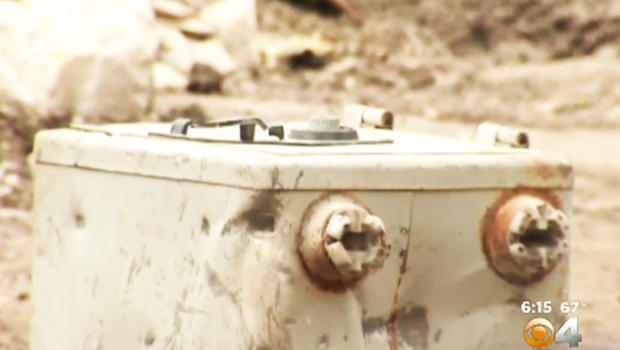
Workers Find Hidden Safe Under Pablo Escobar’s Former Miami Mansion


Another safe has been found on the property late Colombian drug lord Pablo Escobar in Miami Beach, near a mansion that was believed to be used for a stash house.

While he was using an excavator, construction worker Miguel Mato found the safe hidden in the concrete foundation, in the last wall to be knocked down. The combination-locked safe is two feet by two feet and weighs hundreds of pounds.

Originally, the property owner, Christian de Berdouare, didn’t believe Mato found a safe in the mansion that belonged to “El Patron”.

Mato said:

I told the owner, ‘Look there’s a safe. And he thought I was messing with him, and I said, ‘No there’s a safe for real.”

Escobar, nicknamed “El Patrón”, which means “The Boss”, bought the property in March 1980 for $762,500, according to Miami-Dade County public records. Pablo Escobar’s name is listed in a document transferring ownership of the property.

The U.S. government seized the property in 1987 and in 1990, it was acquired by a private owner. The mansion had four bedrooms, six bathrooms, a pool and garage. It sat vacant for years after it was heavily damaged by a fire.

Rapper The Game Donates $500,000 to Provide Water to Flint, Michigan Residents

Phone Tracking App Eroniously Leading People To Atlanta Couple’s Home

  
For months now, angry strangers have been showing up at Christina Lee and Michael Saba’s front door with a curious demand: “Give me back my stolen phone!”

Sometimes, families will show up; other times, it’s groups of friends or a random person with a police officer in tow, according to Fusion. 

Despite using different service providers, everyone who bangs on their door has been led to the suburban Atlanta home by a phone-tracking app.

The problem — as the couple desperately tries to explain visitors — is that the missing phones aren’t at the house and never have been.

They are not, in fact, thieves. Saba is an engineer; Lee is a journalist.

The pair doesn’t understand why exactly, but both Android and iPhone users on various networks are being directed to their house by phone-tracking apps.

Once the awkward situation is explained, most lost-phone-seekers are understanding. But the couple told Fusion that a smaller number of people who place absolute faith in their tracking technology are convinced that the couple is lying, provoking potentially volatile conflicts.

Saba told Fusion by email:

“My biggest fear is that someone dangerous or violent is going to visit our house because of this. If or when that happens, I doubt our polite explanations are gonna go very far.”

“The majority of incidents happen later at night, after dinner,” Lee told the BBC, noting that neither she nor Saba have an idea why the problem persists.

On several occasions, Fusion reports, the problem has led to serious misunderstandings, such as an incident in which the couple briefly became suspects in a missing persons case:

In June, the police came looking for a teenage girl whose parents reported her missing. The police made Lee and Saba sit outside for more than an hour while the police decided whether they should get a warrant to search the house for the girl’s phone, and presumably, the girl. When Saba asked if he could go back inside to use the bathroom, the police wouldn’t let him.

“Your house is a crime scene and you two are persons of interest,” the officer said, according to Saba.

Read more of this story and see the video on Washington Post